
Both of our preamplifiers do the same basic job: they take the tiny signal from a passive piezoelectric hydrophone and turn it into something a recorder, audio interface or oscilloscope can use. Both are designed for hydrophones of 10–30 nF, both have the same five gain settings (5, 15, 25, 35 and 45 dB), and both run on batteries.
The difference is what they measure. The RigidEnhancer 1.1 amplifies the hydrophone’s voltage. The RigidEnhancer 2.0 measures its charge. That one difference shapes everything below. All figures come from the two published specification sheets and are typical bench values into a 10 kΩ load.
At a glance
| RigidEnhancer 1.1 (voltage) | RigidEnhancer 2.0 (charge) | |
|---|---|---|
| Hydrophone capacitance | 10–30 nF | 10–30 nF typical |
| Gain settings | 5, 15, 25, 35, 45 dB | 5, 15, 25, 35, 45 dB |
| Charge sensitivity | 0.09–8.9 mV/pC with a 20 nF hydrophone; changes with capacitance | 1.07–76.1 mV/pC, independent of capacitance |
| Low-frequency response | Flat down to 1 Hz (Direct Mode) | −3 dB at 19–63 Hz, depending on gain |
| High-frequency bandwidth (−3 dB) | >400 kHz at 5 dB, 139 kHz at 25 dB, 18 kHz at 45 dB | 191 kHz at 5 dB, 111 kHz at 25 dB, 86 kHz at 45 dB |
| 50 Hz mains filter | Switchable notch (Hum-Reduction Mode) | Built in, always on |
| Maximum clean output | 10.7–15.2 Vpp | About 12.9 Vpp |
| Batteries | 2 × 12 V A23 | 2 × 9 V |
| Battery life | About 10.6–11.7 h calculated | 58 h measured |
Voltage or charge: what is the difference?
A piezoelectric hydrophone produces an electric charge when sound pressure squeezes it. A voltage preamplifier amplifies the voltage that this charge creates across the hydrophone’s capacitance, so the signal level depends on that capacitance and on the cable, which adds capacitance of its own.
A charge preamplifier holds its input at virtual ground and converts the charge itself into a voltage. Its output no longer depends on the cable length or the hydrophone’s capacitance, so a measurement taken with a short cable and one taken with a long cable can be compared directly. For listening this rarely matters. For measurements you want to compare across days, sites or cable setups, it is the main reason to choose a charge preamplifier.
Sensitivity
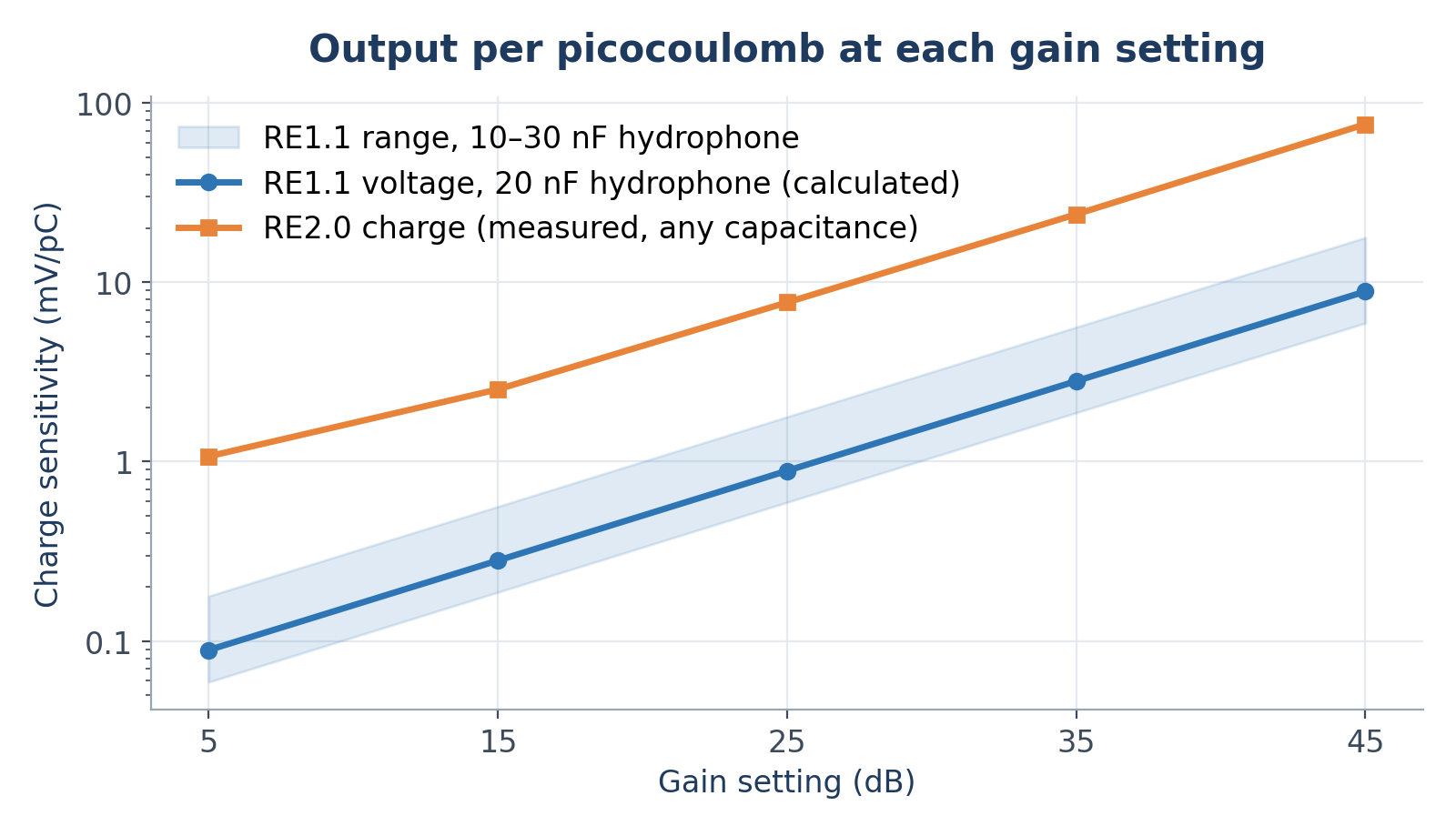
At the same gain setting the RE2.0 gives much more output per picocoulomb. At 25 dB it delivers 7.72 mV/pC, against 0.89 mV/pC for the RE1.1 with a 20 nF hydrophone, about 8.7 times more. The gain numbers on the two dials are therefore not interchangeable: the same hydrophone will sound louder on the RE2.0 at the same setting.
Noise
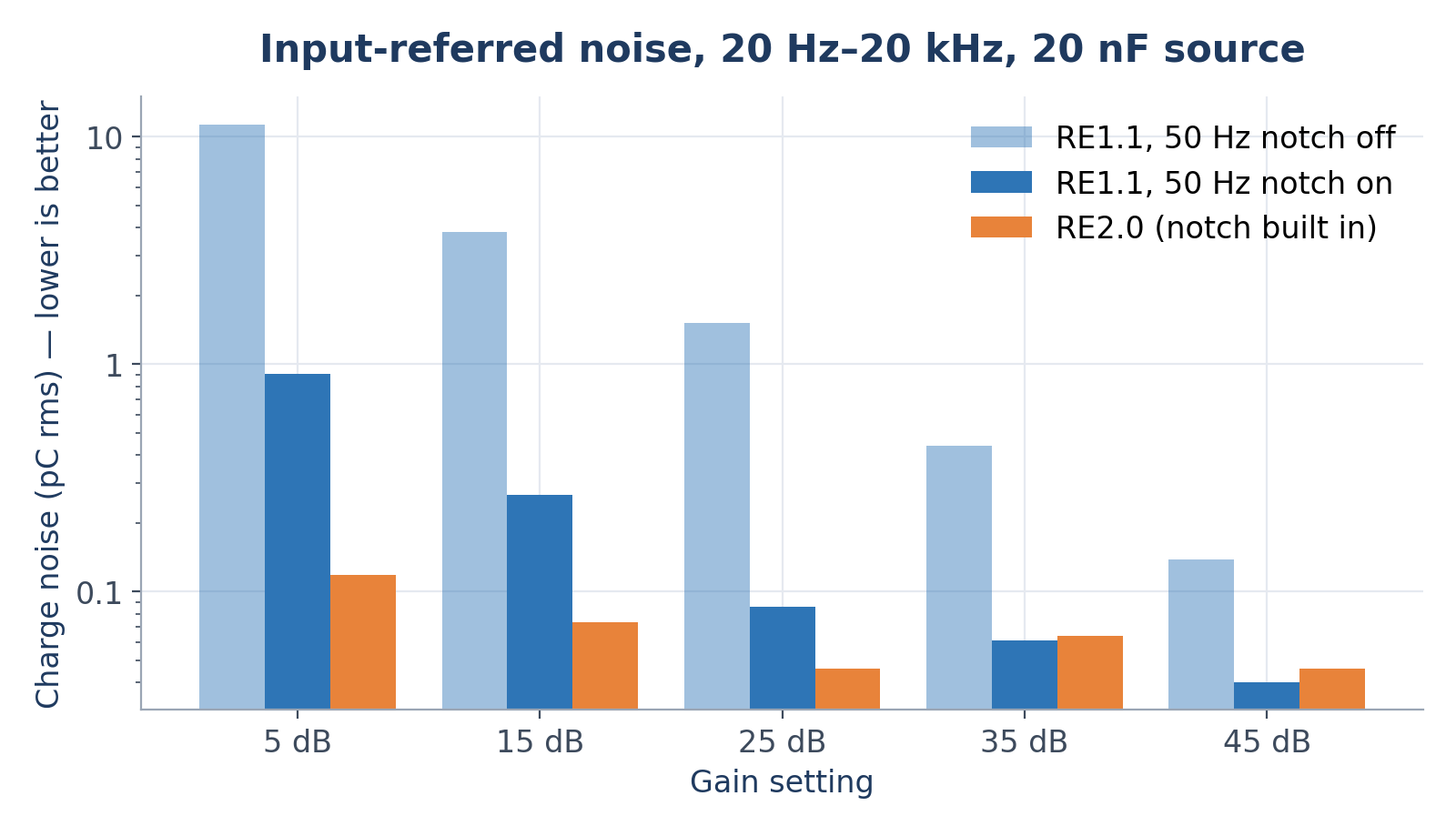
Compared like for like, with the 50 Hz filter in, the RE2.0 is quieter at low and mid gain: 0.118 pC rms against 0.906 at 5 dB, and 0.046 against 0.086 at 25 dB. At 35 and 45 dB the two are effectively the same, around 0.04–0.06 pC rms. With the RE1.1’s notch switched off, its measured noise in this band is 3 to 18 times higher, which is why Hum-Reduction Mode is worth using wherever mains hum is present.
High-frequency bandwidth
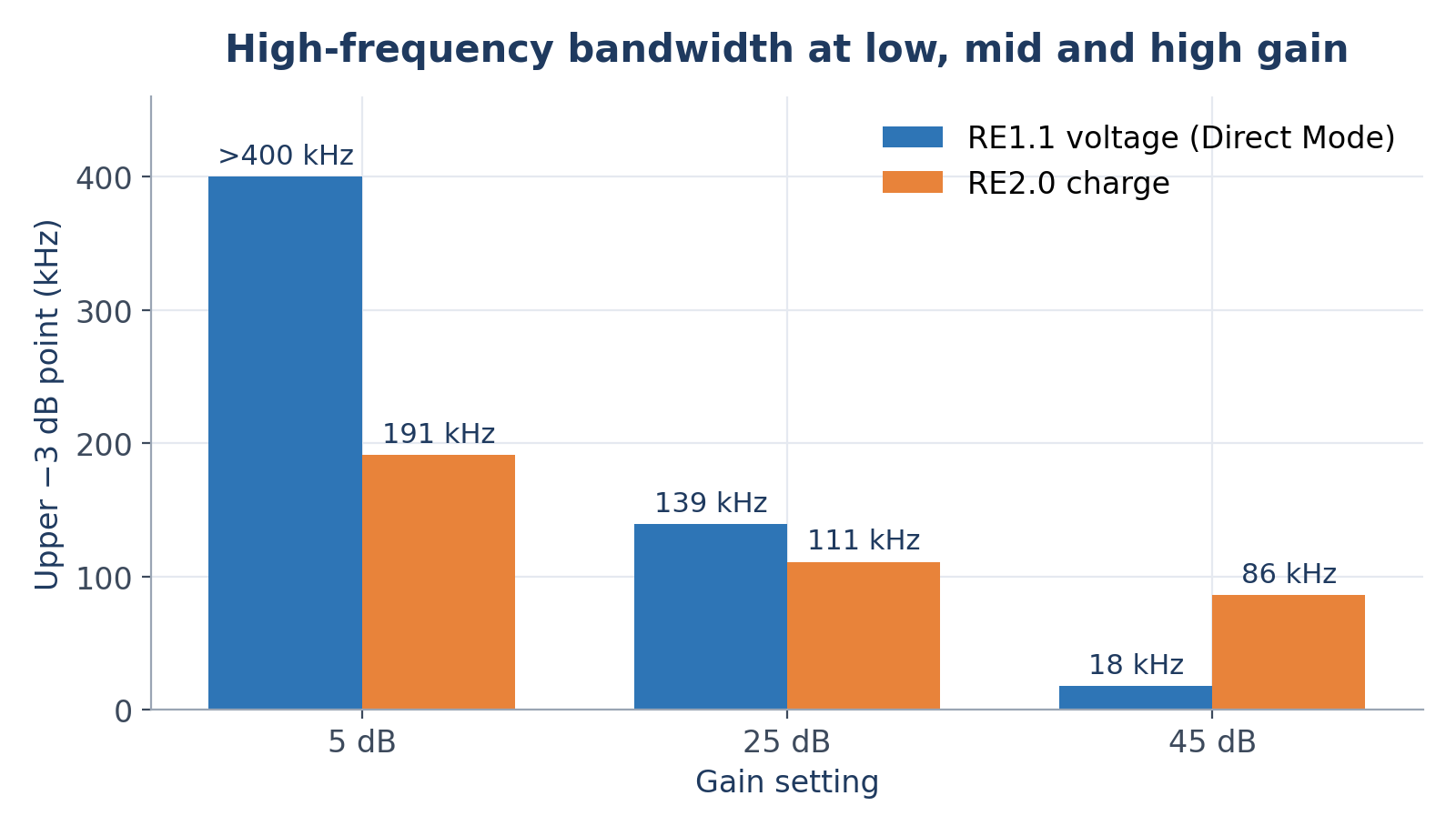
At low gain the RE1.1 reaches highest, beyond 400 kHz at 5 dB, which suits strong wideband and ultrasonic signals. Its bandwidth narrows as the gain rises, to 18 kHz at 45 dB. The RE2.0 keeps most of its bandwidth at every setting and still reaches 86 kHz at 45 dB, so weak signals with ultrasonic content, such as dolphin echolocation or high-frequency leak noise, stay within reach at high gain.
Low frequencies and mains hum
In Direct Mode the RE1.1 is flat all the way down to 1 Hz. Its Hum-Reduction Mode switches in a 50 Hz notch that removes 27–51 dB of mains hum, with the response back within 3 dB above about 430–450 Hz. On the RE2.0 the 50 Hz notch is part of the fixed signal path (25–34 dB of rejection) and its low-frequency response rolls off at 19–63 Hz depending on gain; it is optimised for measurements above about 250 Hz. For work at very low frequencies, the RE1.1 in Direct Mode is the right choice.
Battery life
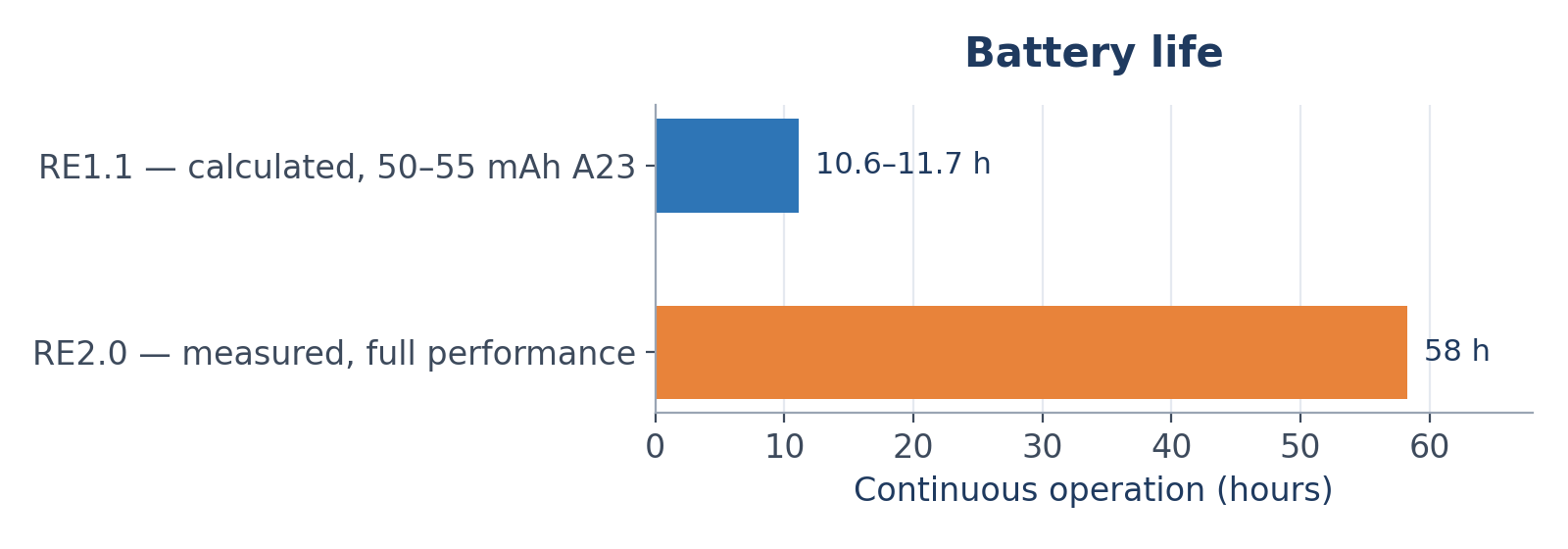
The RE1.1 runs on two compact 12 V A23 batteries at about 4.7 mA per rail. With typical 50–55 mAh batteries that gives about 10.6–11.7 hours of operation by calculation. The RE2.0 runs on two standard 9 V batteries at 8.05 mA per rail and ran for 58 hours at full performance in our endurance test. Driving low-impedance headphones at high gain shortens that, to about 17 hours at 45 dB with 33 Ω headphones.
Which one should you choose?
Choose the RigidEnhancer 1.1 (voltage) if you:
- mostly listen and record underwater sound,
- work at very low frequencies, down to 1 Hz,
- record strong wideband or ultrasonic signals at low gain (beyond 400 kHz at 5 dB),
- want to switch the hum filter on and off as conditions change.
Choose the RigidEnhancer 2.0 (charge) if you:
- take measurements that must be comparable across cable lengths, hydrophones and setups,
- record weak signals with ultrasonic content (86 kHz bandwidth even at 45 dB),
- want the lowest noise at low and mid gain,
- deploy in the field for long stretches (58 hours on one pair of batteries).
Specification sheets
- RigidEnhancer 1.1 specifications and user guide
- RigidEnhancer 2.0 specifications and power consumption
Not sure which suits your project? Contact us and tell us what you want to record.