Specifications Sheet
Power Consumption Sheet
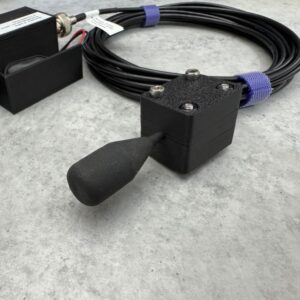
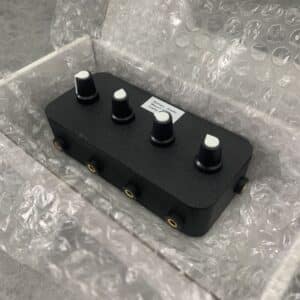
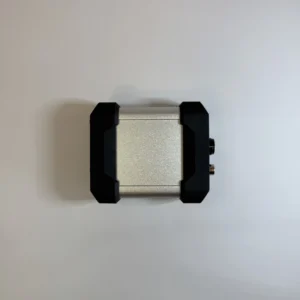
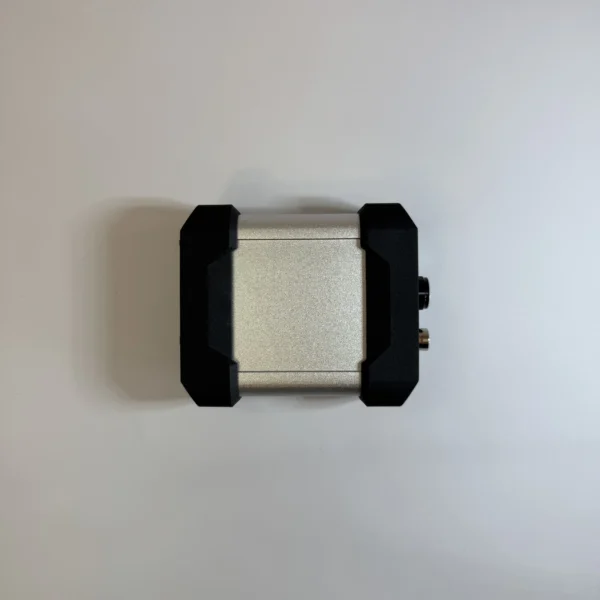
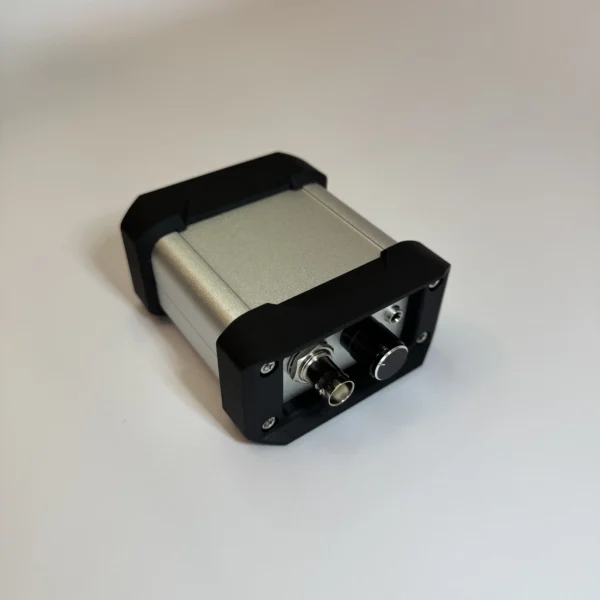
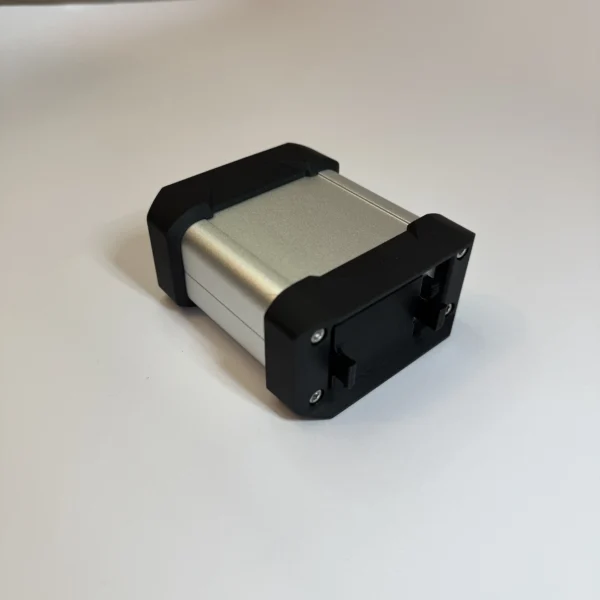
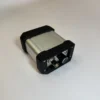
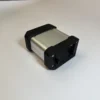
Portable Charge Hydrophone Preamplifier
The Charge Hydrophone Preamplifier is a portable charge-sensitive signal conditioner designed for use with passive piezoelectric sensors in laboratory, field, and industrial measurement applications.
Charge signal conditioning
The preamplifier employs a charge-mode input topology, holding the input node at virtual ground. The output signal is therefore proportional to the charge delivered by the transducer rather than the voltage developed across the cable capacitance. This eliminates the cable-length dependence inherent in voltage-buffered preamplifiers and produces consistent measurements across varying installation geometries, hydrophone configurations, and field deployments. Charge-mode conditioning is the established approach in laboratory transducer measurement and is implemented here in a configuration suited to portable use.
Selectable gain
Five switch-selectable gain positions provide approximately 40 dB of charge sensitivity range. Lower gain positions accommodate high source levels, calibration signals, and transient measurements without overload. Mid-range positions are intended for general-purpose recording. The highest position is optimized for low-level signals, including distant acoustic sources, low-amplitude biological vocalizations, and ranged ultrasonic activity, with correspondingly reduced output headroom. The five-position range allows a single unit to address measurement scenarios that would otherwise require multiple instruments or separate measurement sessions.
Field deployment
The unit is internally battery-powered, removing the requirement for mains supply at the measurement site. Battery operation provides the lowest baseline noise condition, isolates the signal path from mains-borne interference, and simplifies grounding in installations where mains earth introduces ground-loop artifacts.
A 50 Hz mains rejection network is integrated into the fixed signal path. The network attenuates residual mains-frequency interference coupled through the sensor’s cable or the local electromagnetic environment, supporting use in marinas, industrial installations, laboratory buildings, and other environments where mains pickup is unavoidable. The unit is optimized for measurement applications above approximately 250 Hz; low-frequency amplitude accuracy below this region is not preserved by the rejection network.
Audio and ultrasonic operation
The upper passband extends into the ultrasonic region across all gain settings, supporting both audio-band underwater acoustic measurement and ultrasonic transducer applications within a single unit. This includes odontocete echolocation recording, high-frequency leak signature analysis, and laboratory characterization of piezoelectric elements.
Intended applications
- Bioacoustics research and field recording with passive piezoelectric hydrophones
- Underwater leak detection and acoustic monitoring of pipelines and pressurized systems
- University and teaching laboratory transducer characterization
- Custom hydrophone array development and instrumentation prototyping
- Industrial acoustic monitoring of tanks, structures, and process equipment